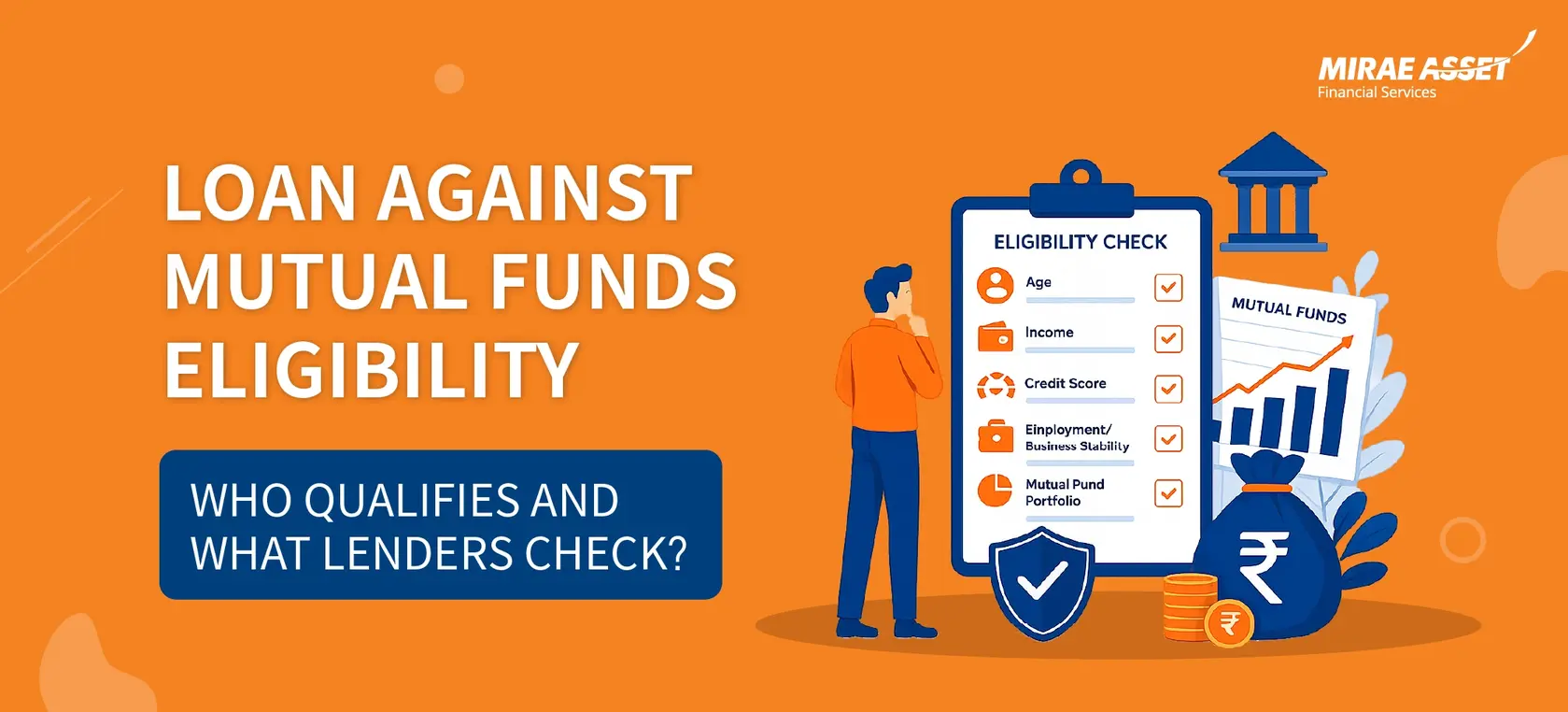
Loan Against Mutual Funds Eligibility: Who Qualifies and What Lenders Check
There’s a quiet assumption most investors carry.
That when you need money, your only real option is to break your investments.
It feels logical. After all, that’s where your money is.
But the moment you actually do it, the regret sets in, taxes eat into your gains, compounding takes a hit, and rebuilding that portfolio suddenly feels harder than it should.
So you start looking for alternatives.
That’s where a Loan Against Mutual Funds becomes useful. It allows you to access liquidity without selling the investments you’ve already built.
However, eligibility for a loan against mutual funds depends on more than just the value of your portfolio.
Factors like :
- how your mutual funds are held
- whether the schemes are pledgeable
- your holding structure
- and whether the process can be completed digitally
can all affect how smoothly your loan gets approved.
Here’s what you should know before applying.
Who Is Eligible for a Loan Against Mutual Funds?
Most investors with KYC-compliant mutual fund holdings are eligible for a Loan Against Mutual Funds.
Since this is a Secured loan backed by investments, lenders usually focus more on:
- the mutual funds you hold
- whether the schemes are eligible
- and how the investments are structured
than only your income profile.
You’re generally in a strong position to qualify if:
- your KYC is complete
- your mutual funds are eligible and pledgeable
- and your holding structure fits the lender’s process
Compared to unsecured loans, the approval process is usually faster and involves minimal documentation.
Are Demat Mutual Funds Eligible for LAMF?
Yes, demat mutual funds are eligible for a Loan Against Mutual Funds.
However, the process may involve additional verification and offline documentation depending on the lender.
If your investments are held in regular (non-demat) format through registrars like CAMS or KFintech, they are usually easier to process digitally.
That’s why many digital-first lenders prefer non-demat holdings for instant approvals.
If your mutual funds are held in demat form through NSDL or CDSL, your application may involve:
- manual verification
- offline paperwork
- or additional operational steps
This doesn’t necessarily make you ineligible.
It simply means the process may not be fully digital.
Who Is Eligible for a Digital Loan Against Mutual Funds?
Most lenders today offer a fully digital LAMF journey, but this convenience comes with a limitation. it is typically available only to individual investors.
If you’re applying:
- as a salaried individual
- or as a self-employed professional in your own name
you can often complete the process online within minutes.
However, if your investments belong to:
- a company
- an LLP
- an HUF
- a trust
- or another non-individual entity
your application may involve:
- additional documentation
- manual verification
- physical paperwork
- and longer approval timelines
In many cases, you may still qualify.
The process just may not be entirely digital.
Can Joint Mutual Fund Holders Apply for LAMF?
Yes, joint mutual fund holders can apply for a Loan Against Mutual Funds.
However, all holders may need to participate in the verification and pledging process.
If your mutual funds are jointly held, lenders may require:
- consent from all holders
- authentication from each investor
- and verification of the holding pattern
The mode of holding can also affect the process:
- Joint
- Either or Survivor
- Anyone or Survivor
This is one of the most commonly overlooked quirks in the LAMF process.
Some digital platforms still struggle with seamless multi-holder authentication, which can slow down approvals even when your investments are otherwise eligible.
Which Mutual Funds Are Not Eligible for LAMF?
Not every mutual fund can be pledged for a loan.
Lenders commonly avoid:
- closed-ended mutual funds
- low-liquidity schemes
- highly volatile sector funds
- and schemes outside their approved list
If your mutual funds are closed-ended, they may not qualify because they cannot be redeemed before maturity.
From a lender's perspective, liquidity matters. If a borrower defaults, the lender needs the ability to liquidate the pledged investment.
Even among open-ended funds, lenders may apply internal filters based on:
- liquidity
- volatility
- concentration risk
- and fund category
This is why two investors with portfolios of similar value can still experience different approval outcomes.
What Documents Are Required for LAMF?
Most lenders require minimal documentation for a Loan Against Mutual Funds application.
Commonly required documents include:
- PAN card
- Aadhaar card
- KYC verification
- mutual fund holding statement
- bank account details
- and signature verification in some cases
If your investments are:
- jointly held
- in demat form
- or owned by a company, LLP, or HUF
you may need to submit additional documents.
For eligible non-demat holdings, many lenders can complete the process entirely online.
How Much Loan Can You Get Against Mutual Funds?
The loan amount you can receive depends on:
- the value of your mutual funds
- the type of schemes pledged
- and the lender's Loan-to-Value (LTV) policy
Typical LTV ranges are:
- up to 45-50% for equity mutual funds
- up to 70-80% for debt mutual funds
Debt funds usually receive higher LTV ratios because they are considered less volatile than equity-oriented schemes.
How Long Does Loan Against Mutual Funds Approval Take?
Approval timelines depend on:
- the lender
- the type of mutual funds pledged
- and your holding structure
If your holdings are eligible and held in non-demat format, digital approvals can sometimes happen within 15 minutes.
However, applications involving:
- demat holdings
- joint holders
- companies
- LLPs
- or HUFs
may take longer because of additional verification requirements.
Operational simplicity often plays a bigger role than investors realise.
Common Reasons LAMF Applications Get Delayed
Loan Against Mutual Funds applications are generally faster than traditional loans, but delays can still happen.
Common reasons include:
- incomplete KYC
- unsupported mutual fund schemes
- demat-held investments
- joint-holder verification issues
- mismatched signatures
- and incorrect bank details
In many cases, delays are operational rather than financial.
Understanding these details beforehand can help you avoid unnecessary friction during the approval process.
Why Loan Against Mutual Funds Eligibility Is Becoming Easier
As lenders continue investing in digital infrastructure, many limitations around:
- demat holdings
- joint accounts
- and operational verification
are gradually improving.
This means the Loan Against Mutual Funds process is becoming faster and more accessible for a wider range of investors.
But for now, understanding these operational nuances can still give you an advantage.
Because eligibility isn't just about whether you qualify.
It's also about how smoothly your investments move through the lender's process.
Final Thoughts
You might assume accessing liquidity requires selling your investments.
But if you've already built a mutual fund portfolio, you've already created value.
A Loan Against Mutual Funds helps you access liquidity without stepping away from your long-term investments, offering an alternative to redeeming your mutual fund investments
And once you understand how eligibility actually works, the process becomes much easier to navigate.
Things You Should Know About Loan Against Mutual Funds Eligibility
In most cases, no. Closed-ended mutual funds are generally not accepted as collateral because they cannot be redeemed before maturity, making them less liquid for lenders.
The loan amount depends on the value and type of your mutual funds. Typically, lenders offer up to 50% of equity fund value and up to 70–80% of debt fund value, subject to internal risk policies.
Not necessarily. Since this is a secured loan, many lenders have flexible credit score requirements. However, a better credit profile can help you get more favourable terms.
If the value of your pledged mutual funds falls significantly, the lender may issue a margin call. You may need to add more units or partially repay the loan to maintain the required collateral value.